Oura, WHOOP and Garmin: what HRV, sleep and readiness scores actually mean
A practical guide to reading wearable data — what is signal, what is noise, and when expert interpretation is worth it.
HUMAX Editorial & Bio-Tech Advisory
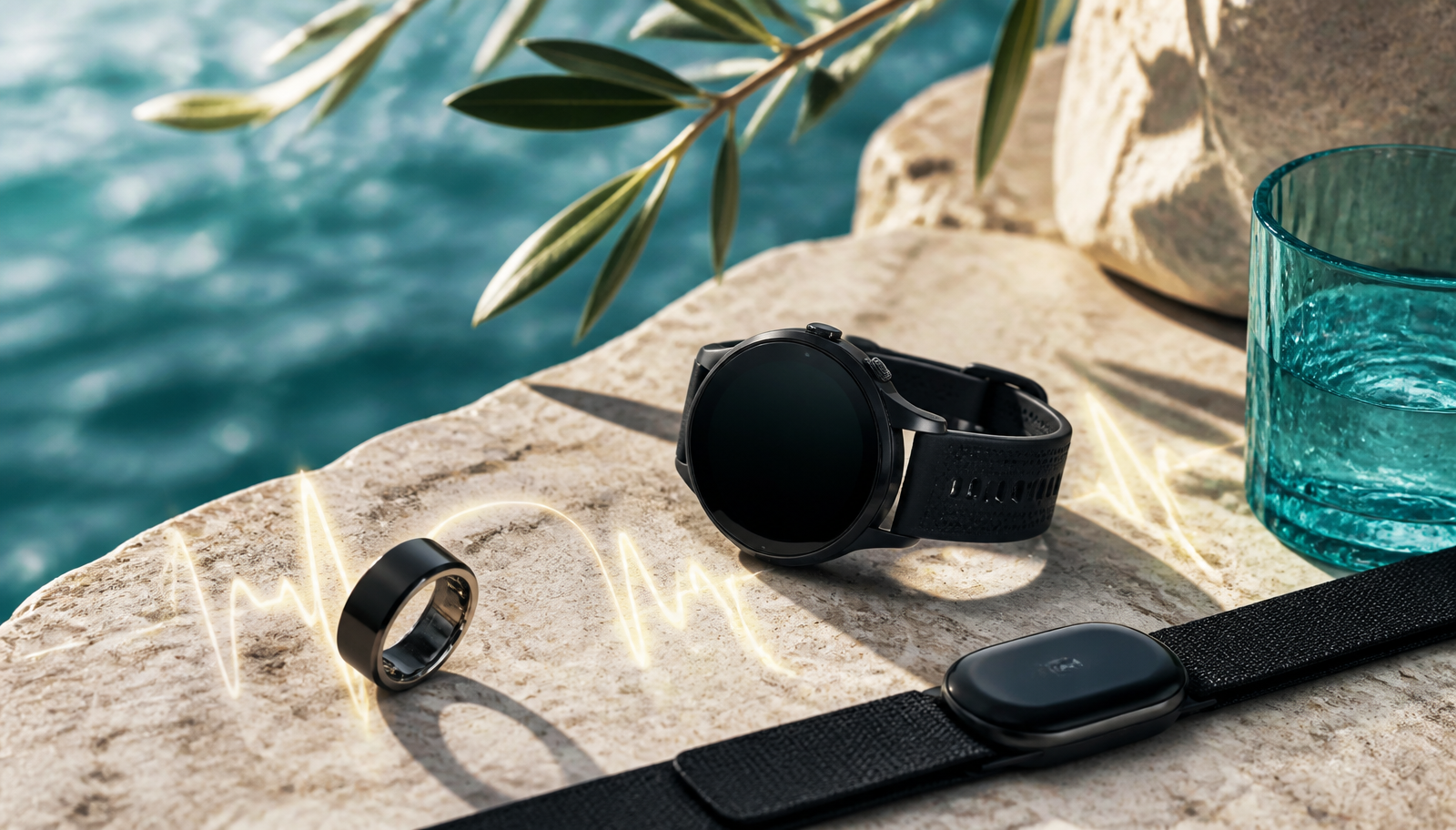 AI-generated image
In a few short years wearables have gone from a sports accessory to the most widespread source of biological data there is. Oura Ring, WHOOP, Garmin, Apple Watch and Samsung Galaxy Watch measure heart rate, heart rate variability, skin temperature, respiration and sleep every single day.
The problem isn't a lack of data — it's interpretation. Most users look at one number a day, the readiness score, and draw conclusions from it, even though that score is only a summary of several raw metrics combined by the manufacturer's own formula.
This guide explains what devices actually measure, how to read individual metrics, and where consumer technology reaches its limits. The aim isn't to replace professional assessment, but to help you draw useful conclusions from data you already have.
1. What devices actually measure — and what they don't
Almost all consumer devices use an optical sensor (photoplethysmography): an LED illuminates the skin and the sensor measures changes in reflected light caused by each heartbeat. Heart rate, heart rate variability and respiration estimates are calculated from that signal.
Everything else — sleep stages, energy expenditure, strain, readiness — is derived by an algorithm. That's not a flaw, but it matters: the device doesn't "see" deep sleep, it infers it from heart rate, variability and movement.
The practical consequence: absolute values are not comparable between devices, while trends within the same device are useful. A ring measures at a different site than a watch and will show different numbers — which doesn't make either of them wrong.
- Directly measured: heart rate, variability, movement, skin temperature.
- Algorithmically derived: sleep stages, strain, readiness scores.
- Compare yourself to your own baseline, not to other people's numbers.
2. HRV: a marker of autonomic balance
Heart rate variability (HRV) is the variation in time between consecutive heartbeats. Higher variability usually means the parasympathetic ("recovery") branch of the autonomic nervous system is more active; lower values often accompany stress, illness, alcohol, insufficient sleep or excessive training load.
Crucially, HRV is highly individual. A value of 45 ms can be excellent for one person and a sign of decline for another. The only meaningful comparison is your own 14- to 30-day average and the deviation from it.
Timing matters too. Nocturnal HRV (Oura, WHOOP) is far more stable than daytime spot measurements, because sleep removes the influence of posture, movement, caffeine and stress.
| Deviation | Common explanation | Sensible response |
|---|---|---|
| Within normal fluctuation | The body is in balance | Continue as planned |
| Moderately below average for 1 day | Poor night, alcohol, late meal, stress | Keep the day, lower intensity |
| Clearly below average for 2–3 days | Accumulated load or an incipient infection | Easier days, prioritise sleep |
| Drop alongside rising nocturnal heart rate and temperature | A common pattern before illness | Pull back intensity, consult a physician if needed |
The table is an educational description of patterns, not a diagnostic tool. Persistent deviations belong in professional care.
3. Sleep: structure matters more than the score
A sleep score summarises several variables: duration, efficiency, sleep latency, awakenings, the share of deep and REM sleep and nocturnal heart rate. Because all of that is compressed into one number, two very different nights often end up with the same score.
It's more useful to look at three things separately: when you fell asleep (consistency), how much deep sleep you got in the first half of the night, and whether nocturnal heart rate dropped to your usual floor after sleep onset.
If nocturnal heart rate stays elevated through the first half of the night, it's often linked to a late meal, alcohol or high daytime load — and it explains feeling unrecovered despite "enough" hours in bed.
- Consistent sleep timing is the single strongest lever on the score.
- Deep sleep clusters in the first half of the night, REM in the second.
- Alcohol typically raises nocturnal heart rate and lowers HRV even when the score still looks decent.
4. Readiness scores: what they really tell you
Readiness (Oura), Recovery (WHOOP) and Body Battery or Training Readiness (Garmin) are proprietary formulas. Broadly, they all compare your nocturnal HRV, nocturnal heart rate, sleep and recent load against your own baseline.
So the score isn't an objective measurement of readiness — it's an early-warning system. Its greatest value is flagging a deviation you can't feel yet: the second day after hard travel, or the day before an infection announces itself.
In practice we suggest a simple rule: let the score shape training intensity and the scheduling of demanding cognitive work, not the decision of whether to do anything at all.
- A low score together with elevated nocturnal heart rate is a more reliable signal than a low score alone.
- A single drop is not a trend; base decisions on three to seven days.
- Don't compare your score with someone else's — the formulas are calibrated to different baselines.
5. The seven-day review: turning data into decisions
The fastest way to make a wearable useful is a structured weekly review instead of daily screen-staring. Write down four numbers: average nocturnal HRV, average nocturnal heart rate, average sleep onset time and the week's total load.
Then add the context the device can't see: travel, alcohol, illness, exams, deadlines. Most "unexplained" drops become obvious once the data is lined up against the calendar.
When patterns are visible but unclear — persistently low HRV despite good sleep, or a nocturnal heart rate that never settles — expert interpretation alongside laboratory and functional measurements is the sensible next step. The device shows that something deviates; measurements show why.
Frequently asked questions
- Which device is most accurate — Oura, WHOOP or Garmin?
- For nocturnal metrics (HRV, heart rate, temperature) rings and straps are generally more stable than watches because they move less. Even so, consistently using one device matters more than the choice between them: trends within a device are useful, absolute values across devices are not comparable.
- Why is my HRV low even though I sleep well?
- Nocturnal HRV also depends on age, fitness, alcohol, hormonal cycle, infections, medication and chronic psychological load. A persistently low value despite good sleep is a good reason for expert interpretation and further measurement, not for self-directed intervention.
- Can a wearable detect a sleep disorder?
- No. A device can surface suspicious patterns (frequent awakenings, elevated nocturnal heart rate, oxygen saturation dips), but diagnosing sleep disorders requires an appropriate specialist and dedicated investigations.
- How does HUMAX help with this?
- We set the devices up correctly, export and consolidate the data, and organise interpretation with the right specialist, together with laboratory and functional measurements where needed. It starts with an introductory consultation and triage.
Guides cover general principles. Translating them to your own data starts with an introductory consultation and triage (€150, 45 minutes) — it results in a written proposal for the measurement scope, with no obligation.